On this page
Articles
What Does a RAADS-R Score Mean? Cutoff and Score Guide
A RAADS-R score shows how your answers line up with common autistic traits. At 65 or above, formal evaluation may be worth it—but the test screens; it does not diagnose.
Quick answer
A RAADS-R score estimates how closely your answers match common autistic traits in adults. The cutoff most sites cite is 65. Full meaning depends on score range, subscale pattern, and factors such as masking or anxiety.
Key takeaways
- A score below 65 usually suggests fewer autistic traits on this screen.
- A score of 65 or above often means formal evaluation may be worth exploring.
- A high score is not the same thing as a formal diagnosis.
- The best reading combines score ranges, subscales, and lived experience.
A brief note
This guide explains RAADS-R totals after the RAADS-R. It does not diagnose autism. Only a qualified clinician can do that.
You have a number. What does it mean?
You answered 80 items. Your total sits between 0 and 240. Almost every guide points at 65. So what does your number tell you?
Short answer: the score shows how strongly your answers match common autistic trait patterns. At 65 or above, many guides suggest looking into formal evaluation—especially when the items match your whole life story. Below that line, this screen captured fewer traits. Neither result is a diagnosis.
Treat the number as organised evidence for reflection or a clinical conversation—not as a finished identity label. Two adults with the same total can feel very different day to day. Subscale pattern, masking, and co-occurring conditions all shape the picture.
Score ranges and the 65 cutoff
A simple first cut:
- Below 65: fewer traits captured on this tool
- 65 and above: answers more consistent with common autistic trait patterns; evaluation may be worth exploring
A more graded reading many adults find useful:
- Below 65: lower screening likelihood on this instrument (still check masking if recognition is high)
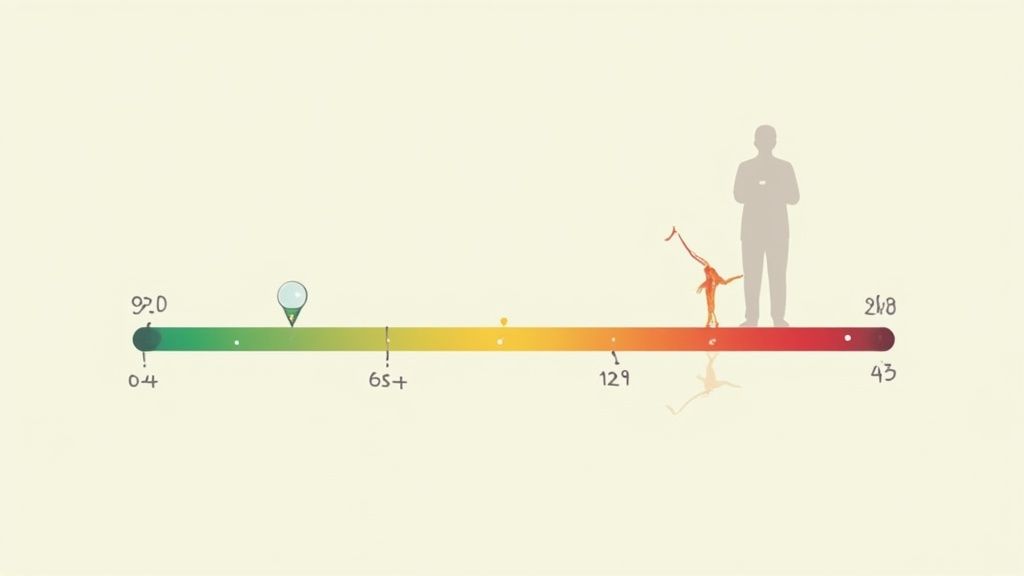
- 65–90: moderate screening signal
- 91–130: strong screening signal
- 130+: very strong alignment with patterns reported by many autistic adults
Adjacent scores are close. A 64 and a 66 should not be treated as opposite destinies. Cutoffs create a useful reference; they do not create certainty. More on how the threshold works: RAADS-R cutoff explained.
Newer clinical work also cites higher bands near 106 and 140. See RAADS-R score ranges: 65, 106, and 140 for that map.
If you are comparing tools, RAADS-14 is a shorter first-pass screen. RAADS-R is the fuller 80-item version. Comparison: RAADS-R vs RAADS-14.
The four domains behind the total
The 80 items feed four subscales. The total gives the headline. The domains show where the pattern sits.
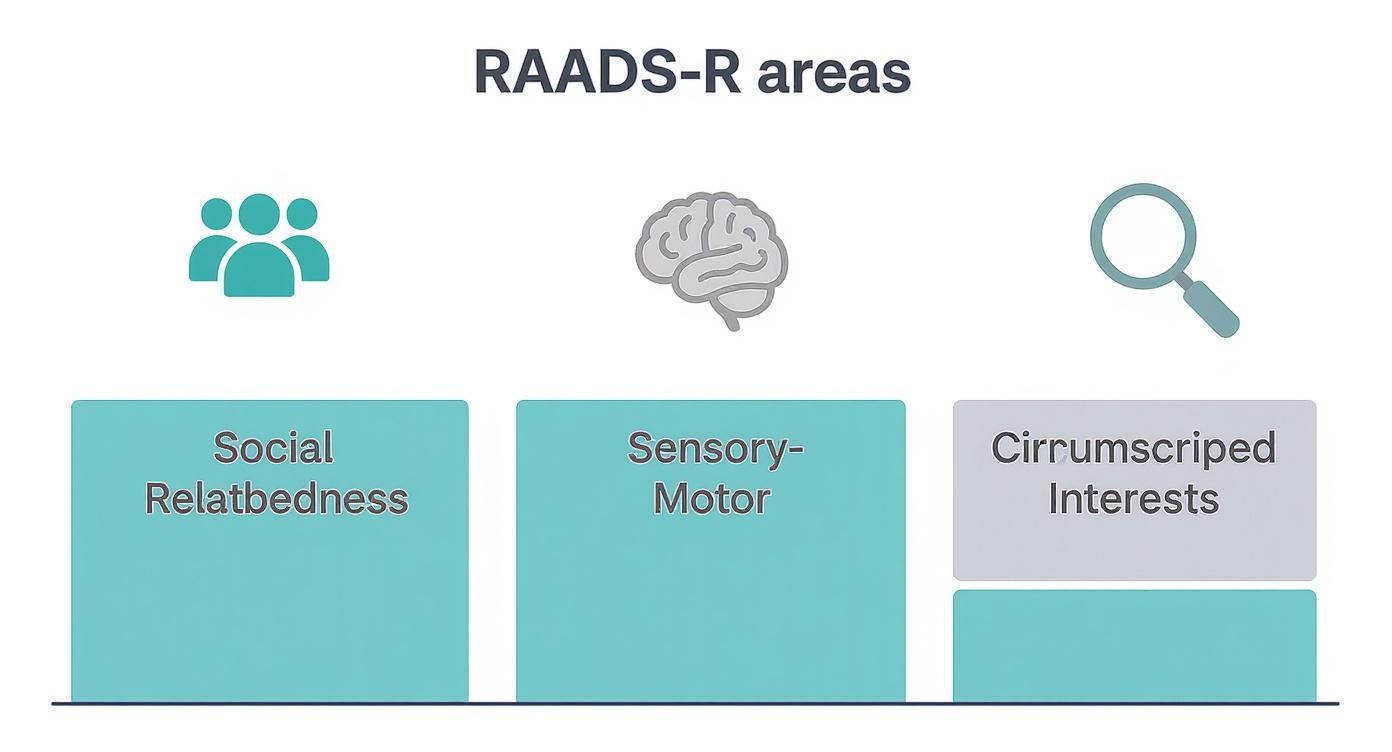
Social relatedness
This area looks at the cost of social life: effort, confusion, motivation, and connection style. High scores often mean socialising feels performed or mentally heavy. They do not mean you dislike people.
Language
This area focuses on how you use language day to day: literal interpretation, small-talk strain, trouble with sarcasm, and conversational timing. You may be articulate on paper and still find everyday chat hard to read.
Sensory-motor
This area covers sound, light, texture, touch, movement, and coordination. It includes both over- and under-responsivity. It can also include stimming or motor awkwardness others called clumsiness.
Circumscribed interests
This area looks at depth of focused interests and preference for predictability. A high score is not just “having hobbies.” It often points to interests that calm or organise daily life.
Two people with the same total can feel different if their subscale spikes differ. A fuller walkthrough is in RAADS-R results explained.
Why a high score is not a diagnosis
A high score means your self-report overlaps with traits commonly reported by autistic adults. It does not explain why those answers are high. It does not replace developmental history.
A clinical evaluation adds interview detail and professional judgement. Screening gathers points. Assessment connects them into a life story—and rules other explanations in or out where possible.
Treat 65+ as a reason to look further, not as proof. A very high score is a stronger signal—still not a certificate.
Masking, overlap, and misleading scores
Because RAADS-R is self-report, results depend on self-awareness and how literally you interpret each item.
Masking can lower scores when you answer from polished adult skills instead of instinct, childhood pattern, or internal cost. If you can make eye contact, hold a job, or manage small talk—but only through heavy rehearsal and recovery—capability answers can understate the trait pattern. See High masking and your RAADS-R score and What is autism masking?.
Overlapping conditions can raise scores or muddy interpretation:
- ADHD — executive function challenges, social friction, intense interests of a different flavour
- Anxiety — especially social anxiety and avoidance
- Trauma / PTSD-related patterns — sensory threat responses, relational withdrawal
False positives and false negatives both happen. That is normal for screening tools. Accuracy limits are covered in Is RAADS-R accurate?.
A useful personal check: Did you answer as the adapted adult, or as the person underneath the adaptation? Did childhood items get enough attention? Do subscales tell a clearer story than the total alone?
What to do with your score
If you scored 65 or higher
- Capture real examples across the four domains—from childhood and adulthood
- Gather old school notes, journals, or work feedback if you have them
- Consider referral through a GP or a clinician familiar with adult autism
- Use practical supports now—recovery time, sensory adjustments, clearer communication—whether or not assessment is immediate
Adult pathways in the UK, EU, and US often involve wait time. A concise history document helps you use appointments well.
If you scored below 65 but still identify strongly
Revisit childhood items, camouflaging effort, and whether you rated capability instead of difficulty. A low screen is information—not an automatic close to the question. Borderline scores especially deserve subscale and history review rather than a hard yes/no reading.
If you have not taken it yet
Start the RAADS-R test, then return to this guide with your total and subscales in hand.
For a calm action plan after any result, see After the RAADS-R — practical next steps.
Bottom line
In short: your RAADS-R total is a screening signal—not a verdict. Pair the number with subscales, life history, and masking before you treat it as proof or dismissal. The most useful outcome is clearer next decisions—not endless certainty-seeking from one number.
Frequently asked questions
What does a RAADS-R score of 65 mean?
A score of 65 is the commonly used screening cutoff. It suggests important overlap with common autistic traits and that a formal evaluation may be worth considering.
Does a very high RAADS-R score confirm autism?
No. A very high score can be a strong screening signal, but only a qualified clinician can diagnose autism after a full evaluation.
Why might someone autistic score below 65?
Masking, limited self-awareness, question interpretation, or overlapping conditions can affect the final score. Treat RAADS-R as a screen, not a final answer.